DEFINITION
The High-Trust Hierarchy™
The four layers every high-trust business owner needs to build.
By Stuart Bell
Take the Assessment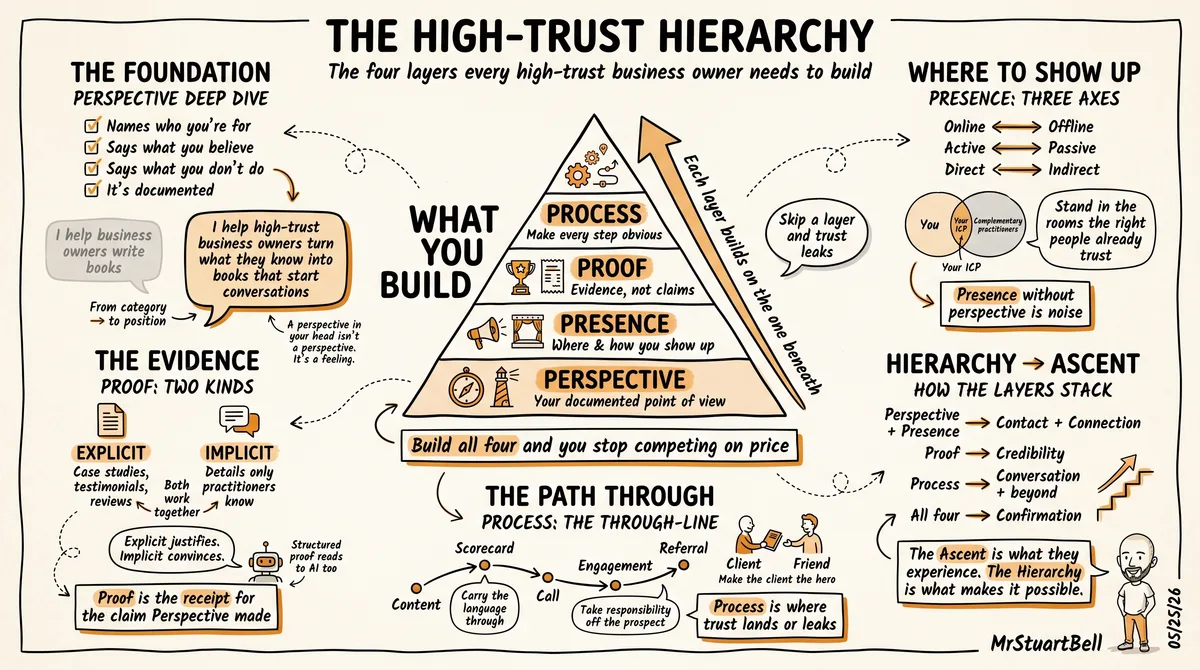
The High-Trust Hierarchy™ is the four layers high-trust business owners build to generate trust, show up strong, and win more of the right clients: Perspective, Presence, Proof, Process.
If you run a High-Trust Business™, the kind where prospects need to feel a connection with a real person before they buy, you've always relied on the conversation to do the heavy lifting. The call, the consultation, the first meeting. That's where you established what you believe, demonstrated you understood the prospect's situation, and earned the trust that closed the work. Most of what your prospects needed to feel confident about you was built in that conversation, often subconsciously, without anyone needing to write it down.
That conversation is getting harder to start.
Referrals are less reliable than they were. Enquiries from the website are down. Prospects who reach out disappear after the first call. The content you produce gets drowned in the volume of generic content everyone else now produces too. And increasingly, the prospect's first questions are answered by an AI assistant that filters who they speak to before they ever pick up the phone.
The trust work used to live in the conversation. Now most of it has to happen before the conversation ever starts. And much of what gets built has to be legible to AI assistants as well as humans, because the AI is now part of the audience deciding whether the conversation happens at all.
The High-Trust Hierarchy is the structure for that work. Four layers, built in order, that take what you used to communicate naturally in the room and make it visible, consistent, and findable everywhere your prospects (and their AI assistants) are now looking.
The four layers are Perspective, Presence, Proof, and Process. Each builds on the one beneath. Skip a layer and the trust you're trying to build leaks. Build all four and you stop competing on price.
Why a hierarchy
These aren't four tactics to pick from. They're four layers that build on each other.
Perspective is the position you take on your clients' problem and the people you serve. It's the layer that makes you recognizable. Without a documented Perspective, nothing else in the Hierarchy has a shape to point at.
Presence is how that Perspective shows up in the world. The places you appear, the rooms you stand in, the channels your prospects actually check. Presence is the layer that turns your Perspective from a private opinion into something the right people can find.
Proof is the evidence your Perspective and your work deliver. It's the layer that converts recognition into confidence, giving prospects the signals they need to believe you can actually do what you say.
Process is how your work feels from the prospect's side, before, during, and after the engagement. It's the layer that carries the trust you've built into the conversation, through the working relationship, and out the other side as the foundation for the next round of clients.
Most high-trust business owners already have a Perspective. It shows up in conversations and meetings, and it's the reason they close clients in the first place. The problem is none of it is documented, and none of it exists outside the call. Presence is usually inconsistent, built from convenience or familiarity rather than a deliberate decision about how to show up. Proof is generic, limited to "some clients liked us," with no real evidence of the specific Perspective or Process at work. And Process is rarely designed to reinforce any of it, which means the trust generated in the conversation leaks the moment the engagement starts.
Of the four layers, Perspective is the one that defines your relationship with clients and shapes everything else you build. That's where we start.
Perspective: the foundation
Your documented point of view on your clients' problem, who you serve, and why you're different.
This is the foundation, and the layer most high-trust business owners haven't documented. Not because they don't have a Perspective, every experienced practitioner does, but because they haven't needed to put it on paper. For years, the Perspective lived in the conversation. It came out naturally when a prospect walked in the door, and the work spoke for itself once it started.
The Perspective you carried in your head, the one that converted in conversation, now has to live somewhere your prospects (and their AI assistants) can find it before any conversation happens. That's what this layer does.
What Perspective actually is
It's a position you can own. Not a tagline. Not a positioning statement. Not "we put clients first." A genuine opinion about the problems your prospects are facing, the people you're best suited to help, and what makes your approach different from the conventional wisdom in your category.
For me, the difference reads like this.
"I help business owners write books and scorecards."
That's a category. It describes the service without differentiating us from every other provider.
"I help high-trust business owners turn what they already know into books and scorecards that reliably start conversations with the people they can help best. No bestseller chase. No DIY tool stack that falls apart after the first click."
That's a position. It tells the prospect who I'm for, what I make, and where I think the standard advice gets it wrong. A prospect who fits that description reads it and recognizes themselves. A prospect who doesn't fit it moves on, which is also useful. The right people self-select in. The wrong people self-select out.
You'll see this Perspective across everything I write. That's the point. Perspective is the only layer of the Hierarchy that takes a position; the other three execute against it. A clear Perspective separates you from the consensus your category averages out to, which is the version that always loses on price.
A clear Perspective separates you from the consensus your category averages out to, which is the version that always loses on price.
Why most owners haven't yet documented theirs
Three reasons, all common, all wrong.
The first is that they haven't needed to. Most high-trust businesses have thrived in the conversation world. They're good at what they do, word of mouth has worked, and sitting down to document what you believe sounds like the kind of work that doesn't produce a quote, a lead, or a billing. Owners push it to next quarter. Next quarter never arrives.
The second is that it feels risky. Taking a position means some prospects will read it and walk away. Owners who've spent years delivering excellent service to anyone who came through the door read this as turning people away. They're optimizing for the broadest possible audience, when in truth their conversations have always been doing the filtering for them. Delivering exceptional service to the right group of people is more successful than trying to be palatable to everyone.
The third is the most common: the assumption that the work speaks for itself. Twenty years in, the owner believes their results, their reputation, and their referrals are enough. And for a long time they were. But "the work speaks for itself" only works when the prospect can see the work. When prospects are flooded with options, and AI assistants don't see the work unless you've made it discoverable, the work no longer speaks for itself. It can't. It's not in the room.
What happens when you skip Perspective
Skipping Perspective doesn't just leave a hole at the foundation. It hollows out the three layers above it.
Presence becomes generic. You show up with the same content everyone else in your category is putting out, with no distinct reason to be there and no reason for people to care. You're a financial planner posting about retirement on LinkedIn. So are forty thousand other people.
Proof loses its weight. A case study is only powerful when it's proving a specific claim to a specific person. Without Perspective, your case studies prove "we're good at what we do," which is what every business says about itself. With Perspective, your case studies prove "we're good at what we do, for this type of person, with this type of problem, and here's what we did and what you can do next." Far more compelling.
Process becomes a formality. Without Perspective, a scorecard is just a form. An intake is just an intake. With Perspective, both become structured reminders that you understand the prospect's situation better than they expected, and opportunities to demonstrate that the way you work matches the position you've taken.
What a strong Perspective looks like
Four markers, roughly in order of importance.
It names who you're for, specifically. Not "businesses" or "professionals" or "high-net-worth individuals." A specific kind of client with a specific kind of challenge. The exit planner working with founders who own concentrated illiquid assets. The veterinarian focused on multi-pet households with chronic-condition animals. The attorney who only takes on creative agencies with founder-led equity structures. Specificity isn't a constraint. It's what allows the right clients to recognize themselves in your work.
It says what you believe. Not "we believe in great service." A real opinion about the problem your clients are facing, and what most people in your category get wrong about it. This is the part owners resist most, usually with "every client is unique" or "it depends." Both are true. But without sharing your Perspective before the conversation, you never get to have the conversation where the detail can come out.
It says what you don't do. The boundary matters. A planner whose Perspective is about business owners with concentrated illiquid assets isn't trying to attract W-2 employees looking for index-fund advice. Saying so, out loud, reassures the right clients that you're focused on them. It doesn't stop you from taking other work if you want it. It just makes sure the conversations you do start are with the people you can help most.
It's documented. Written down. Published. Discoverable. A Perspective that lives in your head isn't a Perspective. It's a feeling. The whole point of this layer is that it can be seen, by prospects, by referral partners, and by the AI assistants increasingly evaluating you on their behalf.
Perspective is the only layer of the Hierarchy that's also a one-time foundational decision. Once you've done the work to document what you believe and who you serve, the next three layers can build at pace. Skip it, and everything you build above has to be revisited every time you try to refresh it.
Presence: where Perspective shows up
Where and how you show up, in the rooms your prospects are already in.
Once you know what you believe and who you're for, you can decide where to be visible. Not before. The most common Presence mistake high-trust business owners make is choosing channels before they've chosen a position. They end up posting broad content on poor-fitting platforms, because they haven't decided who they're talking to.
Presence without Perspective is noise. Presence with Perspective is recognition.
The "where" comes from your Perspective
Perspective named who you serve. Presence is the work of finding the places those people hang out and deciding how to show up.
Your prospects' attention sits across three axes, and Presence means showing up in the right combination of them.
Online and offline. For most high-trust businesses, both matter. Online is where the silent evaluation happens. Offline is where introductions get made. A planner whose Perspective is about founder liquidity events needs to be visible in the online communities those founders read and present in the offline rooms where they gather. Neither alone is enough.
Active and passive. Active is where your prospect is searching for something specific. They've already decided to look. Passive is where they're consuming content for general professional development and stumble across you. Both matter. Active attention converts faster. Passive attention compounds for longer.
Direct and indirect. Direct is where you appear under your own name, on your own channels. Indirect is where you appear on someone else's, or through someone else's voice. Most owners think of Presence as direct only, which is why most owners' Presence stays small. The indirect channels are usually larger, more trusted, and harder to build, and they're where the real reach sits.
Stand in the rooms the right people already trust
The single highest-leverage Presence move for a high-trust business is showing up alongside the people your prospects already take information and advice from.
Every industry has thought-leaders whose voices the right audience already trusts. Podcast hosts. Newsletter writers. Authors. Independent analysts. The people inside a category whose recommendation, mention, or invitation carries weight that no amount of your own posting can replicate. Your prospects are already in those rooms. The question is whether you're in them too.
Getting into those rooms isn't a publicity exercise. It's a Perspective exercise. The people who run those rooms are looking for guests, contributors, and partners with a clear, defensible position they haven't heard from yet. If your Perspective is documented, you've already done most of the work. If it isn't, you'll sound like every other operator pitching for airtime.
Find the overlapping audiences
Beyond thought leaders, there's a second indirect channel most high-trust businesses underuse: complementary, non-competing practitioners whose audience overlaps with yours.
Draw the Venn diagram. Your ICP sits in the middle. On one side is your business. On the other are the practitioners who serve the same people you do, from a different angle or a different stage in their journey, without competing for the same engagement. The exit planner overlaps with the corporate attorney, the M&A advisor, the wealth manager, and the CFO-for-hire. None of them is the planner. All of them are talking to the same founders.
The work isn't to ask those people for referrals. The work is to make yourself useful to their audience, in a way that makes the practitioner look good for putting you in front of them. Write a piece their newsletter would be proud to send. Bring a perspective their podcast hasn't heard before. Offer something their audience would benefit from regardless of whether they ever work with you.
If you do that well, you don't have to ask. The practitioner introduces you because you make them look good. Their audience becomes your audience by association, with the trust already pre-built by the relationship the practitioner has spent years earning. That borrowed trust is the closest thing to a head start that exists in a high-trust business.
The "how" matters as much as the "where"
Showing up in the right rooms with weak material wastes the opportunity. Showing up in the right rooms with your actual Perspective converts attention into recognition.
What changes when Perspective is set is what you put out. The website stops being a brochure and becomes a clear statement of who you help and what you believe about their situation. The LinkedIn posts stop being generic industry commentary and start being your actual opinion about the problem your clients are facing. The podcast appearances stop being "tell us about your business" and start being "here's the thing most people in this category get wrong." The guest article on a partner's blog stops being a thinly disguised pitch and starts being genuinely useful to that partner's audience.
Presence is a decision about where to show up, not a checklist of channels. The right answer depends on where your prospects already are, who they already trust, and which complementary practitioners are already talking to them. Find those three overlaps, show up in them with the position you've taken, and your Presence does work that broadcast volume can't.
The owner who wins isn't the one with the highest follower count. It's the one who shows up in the exact rooms the right prospects are already in, alongside the people those prospects already trust, with a position those people can actually recognize themselves in.
Presence is how Perspective gets found.
Proof: evidence the Perspective delivers
The evidence that your Perspective and Process deliver, tailored to the specific claim you're making.
Proof gets its weight from what it's proving.
A case study that demonstrates "we did good work for a happy client" does almost nothing. A case study that demonstrates the specific Perspective you've taken does almost everything. The veterinarian whose Perspective is about multi-pet households with chronic-condition animals needs case studies of multi-pet households with chronic-condition animals, not generic success stories. The match matters more than the volume.
Explicit Proof and implicit Proof
There are two kinds of Proof, and most high-trust businesses only think about one of them.
Explicit Proof is the asset. Written case studies. Testimonials. Videos. Books. Reviews. Named clients. Third-party coverage in industry publications. Awards and recognitions, when they come from sources your prospects actually respect. These are the obvious proof points. They sit on dedicated pages. They get linked from your homepage. They're what most owners mean when they talk about "social proof."
Implicit Proof is everything else in your content that signals you've done this work before, even when it isn't formally labelled as proof. The article that demonstrates a level of detail only a practitioner who's worked through the problem would know. The podcast appearance where you describe a specific situation with the kind of texture that only comes from having sat across from someone living it. The throwaway aside in a LinkedIn post that mentions a pattern you've seen six times this year. The diagnostic question on your scorecard that no generic operator would have thought to ask.
Implicit Proof is often more powerful than explicit Proof, because it's harder to fake and the prospect's defences are lower when they encounter it. A case study is something you wrote on purpose to convince them. A casual detail in a podcast that lands with uncomfortable accuracy is something they accept with no reason to question it.
The two work together. Explicit Proof gives the prospect something to point to when they need to justify the decision. Implicit Proof is what convinces them in the first place.
Explicit Proof gives the prospect something to point to when they need to justify the decision. Implicit Proof is what convinces them in the first place.
Use the language of your ICP
The right Proof asset described in the wrong language fails the test.
If your ICP describes their situation using specific words, your Proof has to use those same words. The founder facing a liquidity event doesn't talk about "wealth management." They talk about "the sale," "the earn-out," "what I'm taking off the table." A case study that's structured around the founder's actual vocabulary lands differently from one written in industry-side jargon. The prospect reads it and recognizes themselves immediately. The same case study written in advisor-side language reads as something that happened to someone else.
This is where Perspective and Proof reinforce each other. Perspective set the position. Proof uses the position's language to demonstrate that you weren't just guessing. The case study, the testimonial, the article all read in the prospect's terms, from their vantage point, describing the situation the way they would describe it. Not the way you would describe it to a peer.
The detail matters because high-trust prospects spend a lot of time silently evaluating before they engage. They're looking for signals that you've actually sat in the room with someone like them. The faster they find those signals, the faster they ascend through their buying journey.
Structured Proof reads to AI as well as to humans
The other shift worth understanding is what Proof looks like to the AI tools increasingly evaluating you before the prospect ever does.
A human prospect can squint at a poorly structured testimonial and infer what it means. An AI tool can't. AI evaluates Proof on whether it's distinct, specific, and adds information AI hasn't already seen elsewhere. A page that says "great service, highly recommended" adds nothing the AI doesn't already have from a thousand other pages. A page that documents a specific situation, with specific outcomes, in the language of a specific kind of client, adds something genuinely new to what the AI knows about your category. That distinctiveness is what gets you cited when a prospect asks their AI about the problem you solve.
What this means in practice is that Proof needs structure that AI can actually read. Schema markup on case studies, testimonials, and reviews so search engines and AI tools can identify what they are and what they say. Consistent formats, with the client situation, the work, and the outcome in predictable places. Headings and subheadings that make the substance findable without having to parse paragraphs. Categories and tags that group Proof by the type of situation it demonstrates. The work that makes Proof readable to AI is the same work that makes Proof useful to human prospects scanning your site, which is convenient: you only have to do it once.
The honest reality about Proof is that it grows over time. You can't manufacture five years of case studies on a Sunday afternoon. But the work compounds. Each new client who fits your Perspective becomes a candidate for the next case study. Each podcast appearance becomes a piece of evidence that you're known for the specific position you've taken. Each piece of implicit Proof you publish adds another texture point that makes the next prospect's silent evaluation easier.
Proof is the receipt for the claim Perspective made.
Process: the path through
How you make it simple for prospects to take the next step, carrying the trust the other three layers built into the conversation and beyond.
This is the most under-built layer in almost every high-trust business.
Process is the visible mechanism that carries the prospect from "I think this might be the right firm" to "I'm on the call," and beyond that into the working relationship and out the other side as a source of new prospects. Intake forms. Diagnostic tools. Scorecards that pre-qualify and reflect understanding. A first-meeting structure the prospect can see in advance. An onboarding flow that signals competence before any work starts. A delivery experience that's worth talking about. A referral mechanism that doesn't feel like a referral request.
Most high-trust businesses don't build this layer because the work feels like operations, not marketing. It isn't. Process is where the trust the first three layers built either lands or leaks.
Carry the language through
Perspective named the problem in your prospects' own words. Presence showed up with that same language. Proof demonstrated the position using the prospects' vocabulary. Then most high-trust businesses lose all of it the moment the prospect engages.
The contact form reverts to generic firm-speak. The intake email opens with "thank you for your interest." The prospect, who'd been ascending through a coherent experience, suddenly drops into a process that sounds like every other firm they could have called instead.
A real Process carries the language all the way through. The scorecard is framed in the words your prospect actually uses. The pre-call email references the specific problem your Perspective named, not "the challenges in your industry." The proposal sends the client's own language back at them, not the firm's standard template.
Consistency of language is what makes the trust feel continuous instead of episodic. Every time the language shifts, the prospect feels a small jolt of "wait, is this the same firm I was reading?" Every time the language holds, the trust deepens a little more.
Make every step easy and friction-free
The prospect who's read your content, recognized your Perspective, and seen your Proof is ready to take the next step. But "next step" is doing a lot of work in that sentence. If the next step is "fill in a generic contact form and someone will get back to you when they can," you've just told a ready prospect that your firm runs on the same friction every other firm in your category does. Their momentum stalls. The ascent breaks.
Friction shows up in small, ignorable ways that aggregate into a stall. A form with twelve fields when three would do. A scheduling link that requires three back-and-forth emails. A "we'll be in touch" that leaves the prospect wondering when. A first meeting where they don't know what the agenda is. An onboarding where the firm goes quiet for ten days because the work hasn't started yet.
Every friction point you remove is a place the trust stops leaking. The shortest path from where the prospect is to where you want them to be next, every time. If the next step is a scorecard, the scorecard is two minutes, not twenty. If the next step is a call, the call is bookable in one click and confirmed automatically. If the next step is a proposal, the proposal arrives faster than the prospect expected and addresses the specific situation they raised.
The standard isn't "make it possible." The standard is "make it obvious and easy."
Take the responsibility off the prospect
The deeper move inside Process is taking responsibility off the prospect for figuring out what happens next.
Most high-trust prospects are stretched. They're running a business, a practice, a household. They don't have the energy to project-manage your sales process for you. The firm that wins is the one that makes the prospect feel part of the process without having to drive it.
This shows up in small touches. The booking confirmation that tells them exactly what to expect on the call. The reminder the day before that reconfirms what the meeting will cover. The follow-up that arrives without them having to chase. The next step suggested by you, not waited for from them. The proposal that arrives with a clear decision point rather than a request to "let me know your thoughts."
The prospect should feel like they're being carried along by a system that's thought about their situation more carefully than they have. Not because they're being managed, but because the firm has clearly done this before and knows what comes next. Taking the work off them is itself a trust signal. It tells the prospect "these people have a process that works, and I don't have to invent it."
Taking the work off the prospect is itself a trust signal. It tells them "these people have a process that works, and I don't have to invent it."
Continue the language into the work
Process doesn't stop at the conversation. The delivery experience is part of Process too, and high-trust businesses that get this right turn their existing clients into the engine of their next round of clients.
Carry the language of your Perspective into the work. The way you frame the engagement. The way you describe what you're doing as you do it. The check-ins, the updates, the milestones. The way a result gets described back to the client. All of it in the same language the prospect first encountered when they read your content twelve months earlier.
The reason this matters is that the client who lives inside that consistent language for months on end becomes someone who can describe what you do in your own words, without having to think about it. They've absorbed the position. When they recommend you to a peer, they don't say "they're great, you should call them." They say something closer to "they're the firm that gets it right for business owners with concentrated illiquid assets, which is exactly what you're dealing with." The referral arrives pre-positioned because the language carried all the way through.
Make the client the hero of the referral
The last move inside Process is the one almost nobody builds: a referral mechanism that doesn't feel like a referral request.
Most high-trust businesses ask for referrals badly, when they ask at all. The classic version is the awkward "do you know anyone else who might benefit from our services" at the end of an engagement, which puts the responsibility on the client to do the work of identifying, qualifying, and introducing. It also reframes the relationship from "you helped me" to "now you're asking me for something." The energy changes. The referral often doesn't come.
The better mechanism flips two things.
First, it makes the client the hero of their part of the story. The client who refers a friend isn't doing you a favor. They're doing their friend a favor, and by extension demonstrating that they're the kind of person who connects their network to the people who can actually help. The referral is an act of generosity to their friend, not an act of obligation to you. Frame it that way, build it that way, and the client refers because referring makes them look good.
Second, it focuses the value on the person being referred. The friend who's being introduced isn't being asked to consider working with you. They're being given something genuinely useful first. A specific article that addresses the exact problem they're facing. A scorecard that gives them a useful result. A report that's worth reading regardless of whether they ever become a client. The introduction lands as "here's something I thought would help you," not "you should call my guy." Their friend engages with the resource on their own terms, ascends through their own journey the same way every other prospect does, and arrives at the conversation already trusting the source.
The Process you've built for the original prospect is the same Process the referred peer encounters. The language is consistent. The friction is removed. The next step is obvious. The trust carries.
Process is the through-line
A well-built Process is also the layer where humans and AI converge. The prospect who's checked you with their AI tool and decided to reach out arrives at the same clear path as the prospect who was referred by a friend. Both ascend through the same friction-free flow. Both encounter the same language. Both feel the same continuity from first content piece to first conversation to working relationship to onward introduction.
Process is how the trust the other three layers built stops leaking.
How the layers stack to the High-Trust Ascent™
The High-Trust Hierarchy™ describes what the owner builds. The High-Trust Ascent™ describes what the prospect goes through.
The Ascent has five stages: Contact, Connection, Credibility, Conversation, and Confirmation. Each is a step the prospect has to clear before they reach the next, and each is a point where they can quietly fall away. The full treatment of the Ascent lives in its own article. What matters here is which layer of the Hierarchy makes each stage possible.
Your prospect needs to know you exist and recognize that you can help with their specific situation. Without a documented Perspective showing up in the places they're looking, neither of those happens.
Your prospect needs confirmation signals before they pick up the phone. Reviews, case studies, content, third-party coverage. Without Proof demonstrating your Perspective, the prospect quietly moves on at the silent evaluation stage without you ever knowing they were considering you.
Your prospect needs an obvious next step that feels structured rather than scary, and the experience needs to hold through the working relationship and out into the introductions that follow. Without Process, the prospect who was ready to book a call hesitates, and the trust the first three layers built leaks at every transition.
The final stage of the Ascent is the result of all four layers working together. The prospect arrives at the yes because every layer beneath it held.
The worked example
The High-Trust Business™ definition article showed the exit planner from the prospect's side, ascending through the 5 C's. Here's the owner's side. The four layers, built in order, that made every stage of that ascent possible.
He documents his Perspective. Most retirement advice is designed for W-2 employees and gets it wrong for business owners with concentrated illiquid assets. He's for founders heading toward a liquidity event in the next three to seven years. He's not for index-fund-curious salary earners. He believes "diversify early" is the wrong move for his clients, and he can explain why. The position goes on his site, in his bio, in the way he describes himself when he's introduced. Perspective
He builds his Presence around that position. Articles on his site address the specific situation. The podcasts he guests on are the ones his prospects already listen to, founders' podcasts and exit-planning shows, not generic financial-advice channels. He builds relationships with the corporate attorneys and M&A advisors who serve the same founders from a different angle, and shows up in their newsletters with material their audiences find useful. His LinkedIn, his professional listings, his speaker bios all carry the same line. Presence
He documents Proof against the claim. Case studies of founders he's worked with through liquidity events, written in the founders' own language about the sale, the earn-out, what they were taking off the table. Fifteen well-built case studies that prove the exact claim, not a hundred generic happy-client quotes. Structured consistently so they read clearly to both human prospects and the AI tools doing the silent evaluation. Proof
He builds a Process that carries the prospect through. A short scorecard before the call, framed in the prospect's language. A clear description of what the first conversation covers. An obvious next step on every page. The engagement itself uses the same language he's been using publicly for years, so by the time a client is six months in, they describe what he does in his own terms. When the work concludes, the next-step suggestion isn't "do you know anyone else?" It's a specific resource the client forwards to a peer, framed as something the client is doing for that peer, not for him. Process
The prospect from the High-Trust Business definition article moves through Contact, Connection, Credibility, Conversation, and Confirmation because every layer beneath those stages was built to hold. The Ascent is what they experience. The Hierarchy is what makes that experience possible.
The opportunity
If you saw yourself in this article, the work in front of you is clearer than it's ever been.
Most high-trust businesses haven't built any of this systematically. That's why the owner feels like the best-kept secret in their market. The trust is in the room when a prospect actually meets them. It just isn't anywhere the prospect could find before they got there.
The four layers are the fix. Perspective, Presence, Proof, Process. In that order.
The advantage is already yours
The Hierarchy is easy to build when the substance is already there. Practitioners who genuinely do what they say have the advantage, because every layer is documenting something that already exists. The Perspective is the one you've been delivering in conversations for years. The Presence is showing up in places you already know your prospects look. The Proof is the work you've already done. The Process is the way you already work, written down so prospects can see it before the call.
What feels like a mountain of work from the outside is mostly translation. Taking what's already in your head, in your conversations, and in your client relationships, and making it visible to the prospects and AI tools doing the evaluation before you ever get the chance to meet.
The category is yours to build in
The question isn't whether you're a High-Trust Business™. You already are. The question is whether you're going to build like one.
Build the Hierarchy and the rest follows. The right prospects find you. The wrong ones self-select out. The conversations get easier because the prospect arrives already trusting you. The price conversation stops being a conversation at all.
That's the High-Trust Business advantage. It's been there the whole time. The work in front of you is making it visible.
Frequently Asked Questions
What is the High-Trust Hierarchy™?
The High-Trust Hierarchy is the four layers a high-trust business owner builds to generate trust before the conversation: Perspective (your documented point of view), Presence (where and how you show up), Proof (evidence your approach delivers), and Process (making it simple for prospects to take the next step). Each layer builds on the one beneath it.
Who is the High-Trust Hierarchy for?
Any business owner whose clients need to feel a connection with a real person before they buy. Financial advisors, attorneys, architects, remodelers, consultants, dentists, and other professional or home service providers who've always relied on the conversation to close the work.
What's the difference between the High-Trust Hierarchy and the High-Trust Ascent™?
The Hierarchy is what the owner builds: Perspective, Presence, Proof, Process. The Ascent (Contact, Connection, Credibility, Conversation, Confirmation) is what the prospect experiences. The Hierarchy makes the prospect's ascent through the 5 C's possible.
Why does the order matter?
Perspective is the foundation. Without a documented point of view, Presence becomes generic, Proof has no specific claim to demonstrate, and Process has nothing to carry through. Skipping a layer means the trust you're building leaks at every transition.
How does the High-Trust Hierarchy relate to a High-Trust Business™?
A High-Trust Business is a business where prospects need a conversation before they buy. The High-Trust Hierarchy is the structure those business owners build to earn trust before the conversation happens. The full definition of High-Trust Business lives at hightrustbusiness.com.
Go Deeper
THE BOOK
A Brutally Honest Guide to Marketing Your High-Trust Business™
The tactical implementation, layer by layer
ASSESSMENT
Are You a High-Trust Business?
2 minutes. 7 questions. Discover your fit.
MORE WRITING
High-Trust Business on MrStuartBell.com
More writing on everything High-Trust
ASCENT
The High-Trust Ascent™
The five stages every prospect climbs
DEFINITION
What Is a High-Trust Business?
Read the category defining article